Offline media you can measure. Put a QR code on the paper cup at the tea stall, and every scan, every ad view and every tap shows up in your dashboard, stall by stall, as it happens.
Outdoor advertising has always had one weak spot. You can buy the poster, the billboard or the branded cup, but you can't see what happened next. Did anyone look? Did anyone act? Which location worked, and which didn't? The answer usually arrives as an estimate, weeks later, if it arrives at all.
We built something to change that for one of the most ordinary objects in the city: the paper cup at the tea stall.
The idea
In Dhaka, a tea stall is a place where people stop for a few minutes, with a cup in one hand and a phone in the other. That is a quiet moment of attention, at a place people come back to.
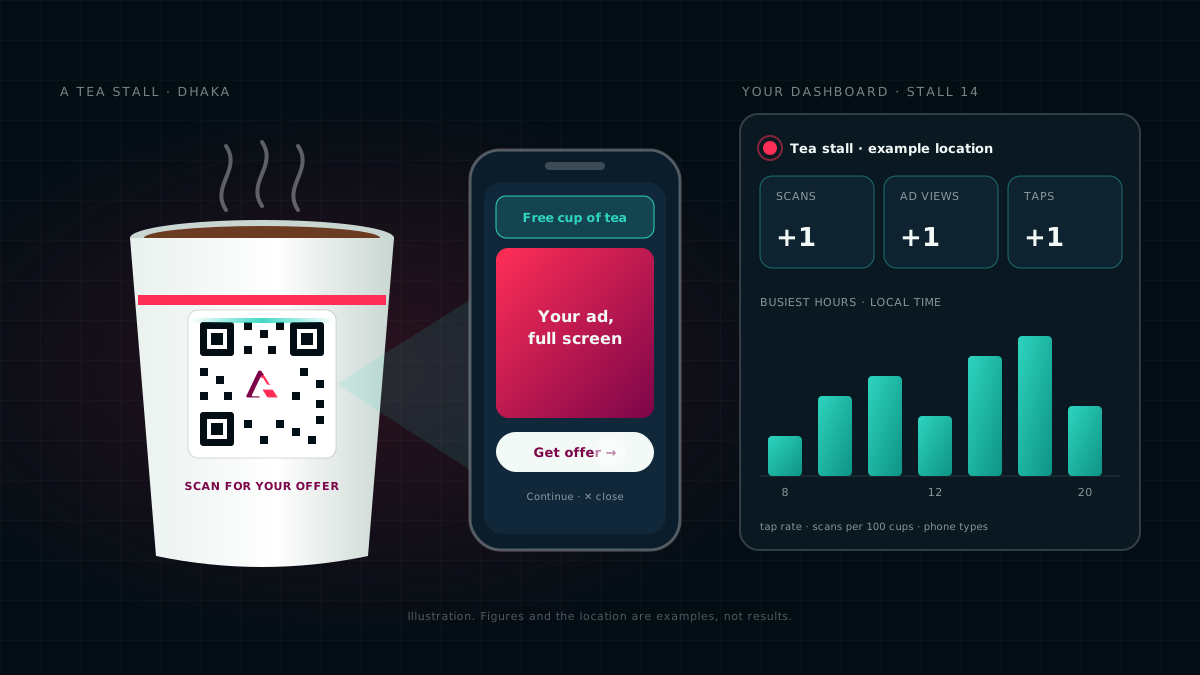
So we put a QR code on the cup. When someone scans it, their phone opens your ad, full screen. One tap takes them to your landing page, your app or your offer. A close button and a Continue link take them to the same page if they would rather skip the ad, so nobody is left at a dead end.
Behind that simple moment is the same ad platform we use for digital campaigns. The cup stops being just print. It becomes measurable inventory: ad space you can count, compare and improve.
What happens in a scan
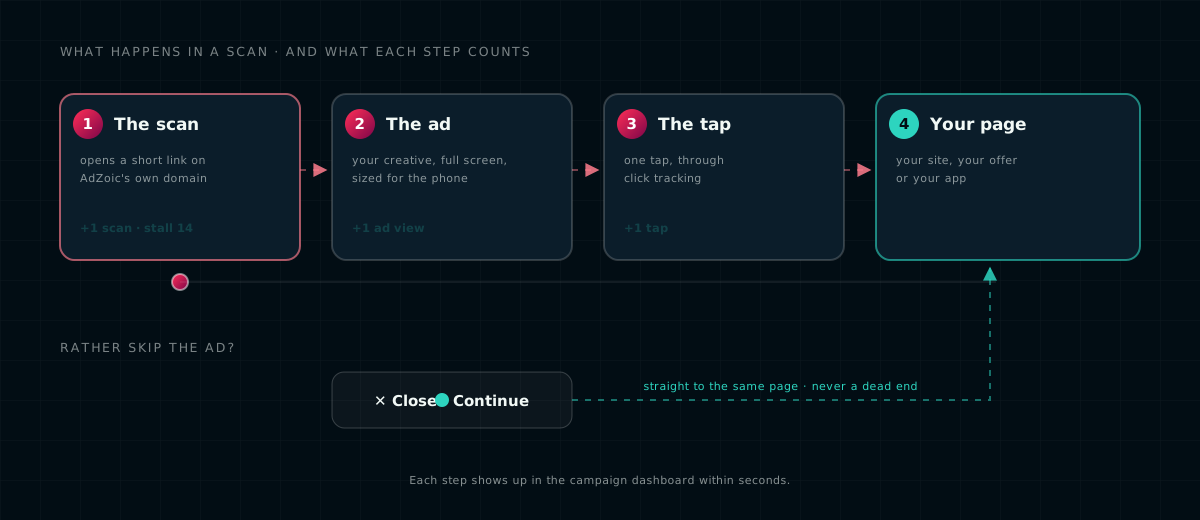
- The scan. The phone opens a short link on AdZoic's own domain. The scan is counted against the exact stall the cup came from.
- The ad. Your creative appears full screen, sized for the phone. That is counted as an ad view.
- The tap. One tap goes through our click tracking to your page. That is counted as a tap.
- Your page. The person ends up where you want them: your site, your offer, your app.
All of it shows up in the campaign dashboard within seconds.
What you can see, stall by stall
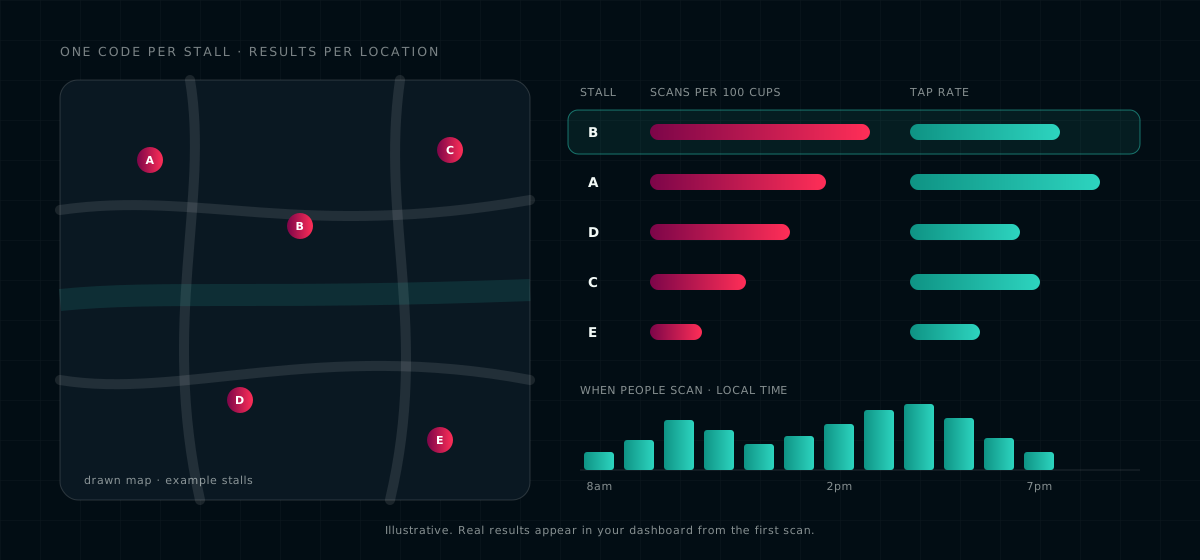
Every stall gets its own code, so results come per location, not as one blended number:
- Scans, ad views and taps for each stall.
- Tap rate: of the people who saw the ad, how many tapped through.
- Scans per 100 cups: how well each stall turns cups into attention.
- Busiest hours for scanning, on local time.
- Phone types: the mix of Android and iPhone among the people who scanned.
That is enough to answer the questions outdoor media could not: which areas respond, at what time of day, and whether the creative makes people act.
The printed code stays. The ad can change.
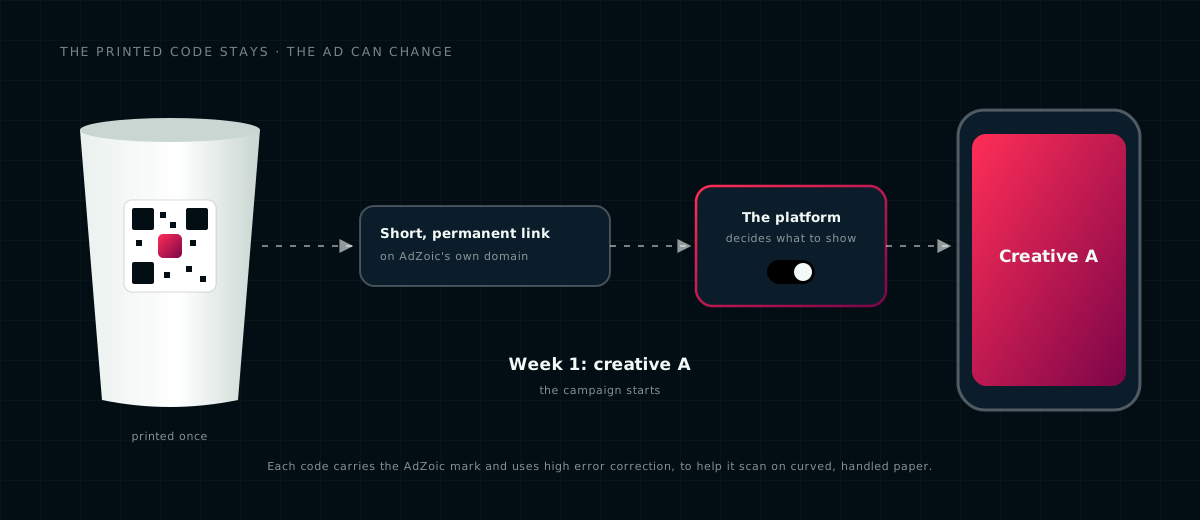
A printed cup can't be updated. So the code never points at your ad directly. It points at a short, permanent link on our own domain, and the platform decides what to show. That means you can:
- Change the creative mid-campaign without reprinting a single cup.
- Switch a code off at any time. A code that is off skips the ad and takes people straight to your page, so a printed cup never goes dead.
Each code carries the AdZoic mark in the centre and is designed to scan on curved, handled paper, with error correction high enough to help it survive a stain or a crease.
Give people a reason to scan
People don't scan a cup just because a code is there. They scan when there is something in it for them: a free cup of tea, a discount, some talk-time. The offer sits right above the ad on the phone screen, so the person sees what they came for straight away.
That is also why we report scans per 100 cups for every stall. It is the honest measure of whether the offer is working, and it is the number we will watch most closely in our pilots.
The brand sets the offer and is responsible for it. Keep the terms clear on the screen (what the person gets, until when, and any limits), honour it at the stall, and follow local rules for promotions. We are happy to help you word it plainly.
What we measure, and what we don't
We measure scans and taps, not who people are.
A scan tells us which stall's cup was scanned, when, and on what kind of phone. We don't collect names, phone numbers or accounts, and we don't ask anyone to sign in. Location comes from the stall itself, which is far more precise than guessing a city from a phone's internet connection.
And because every code opens a link on AdZoic's own domain, the address people see is one they can recognise, not a random redirect.
We think that is the right balance for this kind of media: exact about the campaign, respectful about the person.
QR code: the square pattern a phone camera reads to open a link. Scan: someone pointing their phone at the code. Ad view: the ad appearing on their screen. Tap: pressing the ad to go to your page. Tap rate: taps as a share of ad views. Scans per 100 cups: how many scans every hundred cups produce at a stall. Creative: the ad itself, its picture and words. Inventory: ad space you can buy.
Join the Dhaka pilot
We are opening pilot slots in Dhaka for brands that want to test cup media before a wider rollout, with one brand per category. A pilot runs for a few weeks across a set of stalls, with the results live in your dashboard from the first scan.
When the pilots finish, we plan to publish what we learn: real scan rates, real tap rates, and which locations worked best. Until then, we won't quote numbers we haven't measured.
Questions we get asked
Do people need an app to scan the cup?
No. On most smartphones the camera reads the QR code and opens the link. There is nothing to install and no sign-in.
What does a scan record about the person?
Which stall's cup was scanned, when, and what kind of phone it was. We don't collect names, phone numbers or accounts, and nobody is asked to sign in. Location comes from the stall, not from the person's phone.
Can I change the ad after the cups are printed?
Yes. The printed code points to a short, permanent link on AdZoic's own domain, and the platform decides what to show. You can swap the creative mid-campaign without reprinting a single cup.
What happens if a code is switched off?
The ad is skipped and the scan goes straight to your page, so a printed cup never leads to a dead end.
How do I know which stall works best?
Every stall has its own code, so the dashboard shows scans, ad views, taps, tap rate and scans per 100 cups for each stall, plus the busiest hours, from the first scan.
How can my brand join?
We are opening pilot slots in Dhaka, one brand per category. Talk to us to ask about a slot.
The illustrations in this post are drawings, not screenshots; the stalls, location names and figures in them are examples, not results. Pilot slots are limited and subject to availability and agreement. Offers shown on cups are set and fulfilled by the advertising brand. Android is a trademark of Google LLC and iPhone is a trademark of Apple Inc., named only to describe phone types. Product behaviour described here is how AdZoic works in November 2026 and may change.