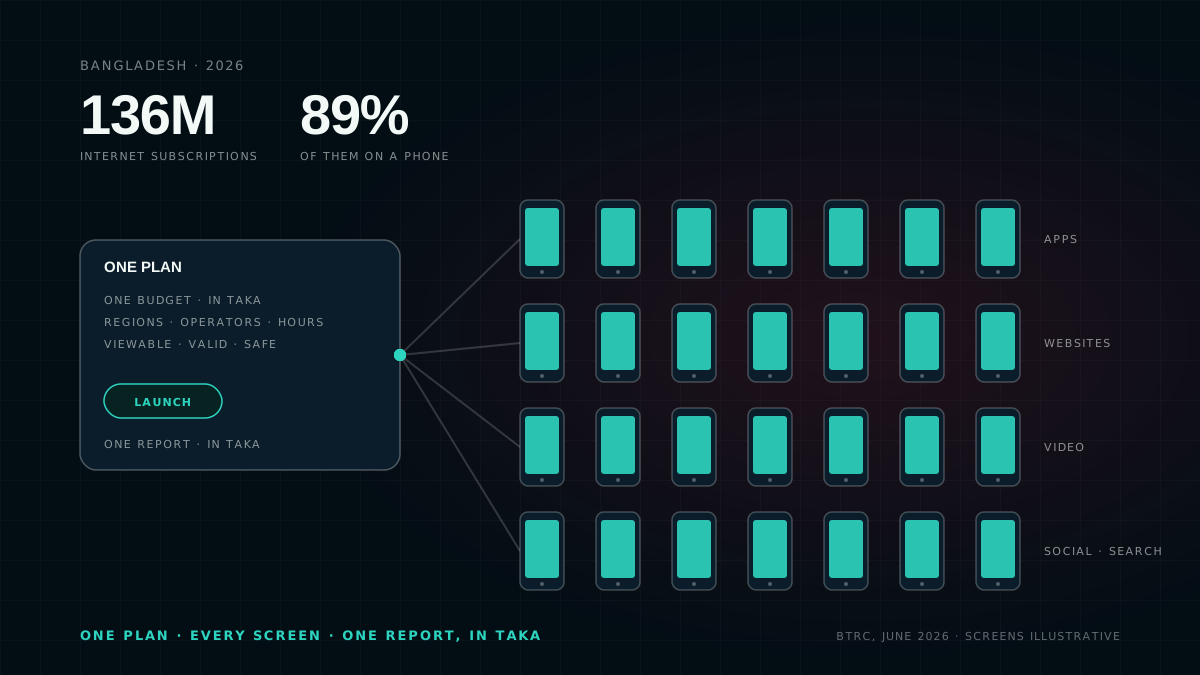
Bangladesh now has more internet subscriptions than ever, and almost all of them live on a phone. Yet most brands still buy that audience one platform at a time, read the results in four dashboards and two currencies, and guess what actually worked. Here is the market in numbers, what gets in the way, and a practical plan to reach every screen from one place.
এক ড্যাশবোর্ডে, প্রতিটি স্ক্রিনে।
One dashboard, every screen.
Bangladesh in numbers
Sources: the telecom regulator's figures for June 2026 as reported by The Financial Express; NapoleonCat for September 2026. Numbered sources are listed at the end.
Digital is where Bangladesh's attention went
At the end of June 2026 the telecom regulator counted 135.94 million internet subscriptions, up from 128.99 million at the start of the year. Mobile subscriptions grew more slowly, to 189.83 million. People are not just buying SIM cards. They are getting online, and 120.84 million of those internet connections run over mobile networks. [1]
Attention follows. On StatCounter's measure of social-media traffic, Facebook holds roughly 79% in Bangladesh and YouTube about 15%. [4] NapoleonCat counts about 72 million Facebook users and 11.5 million Instagram users in the country as of September 2026. [3]
How much money follows is harder to pin down, because every estimate defines the market differently. One research publisher puts digital ad spend at about US$3.8 billion for 2026. [6] A Dhaka newspaper reports a digital marketing market of around US$1.2 billion for 2026, with roughly 45% of advertising expenditure now said to go to digital. [2] A market tracker sized the whole advertising market at about US$669 million for 2025, projecting that 78% of it will be digital by 2029. [5] They disagree on the size and agree on the direction: digital is where the growth is, pushed by e-commerce, food delivery, fintech and online education. [2]
The audience moved to mobile screens years ago. The buying process for most brands has not caught up.
Five problems we hear from every marketing team
- One platform does all the work. Social gets most of the budget because that is where the audience is. When auction prices rise in Eid season, there is no second channel ready to take the spend.
- Four dashboards, no single answer. Social, video, search and the open web each report in their own way. Someone stitches spreadsheets together on Sunday night, and the totals never quite match.
- Results in dollars, budgets in taka. Teams plan in taka and get reports in dollars at whatever rate the platform used. Comparing one month with another becomes guesswork.
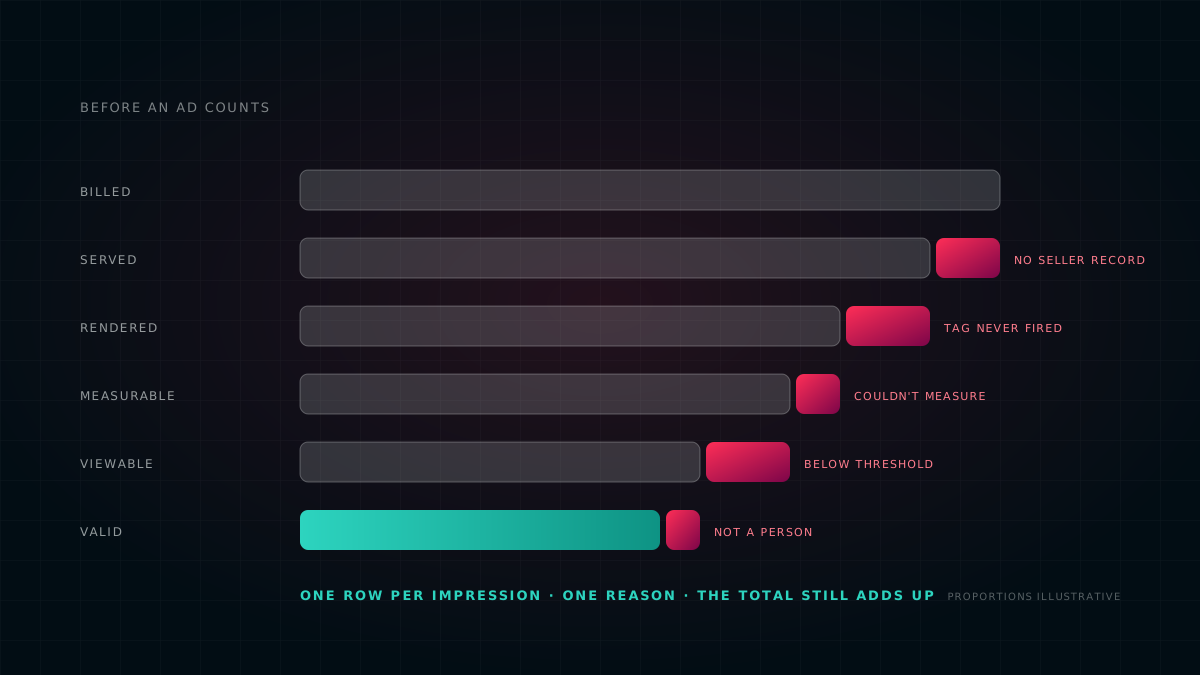
- Impressions nobody saw. On the open web, a cheap impression is often an ad that never appeared on screen, or a visit that was not a person at all. A low price hides it.
- Targeting that ignores how Bangladesh connects. A heavy video creative that plays well on Wi-Fi in Gulshan can stall on a weak connection outside the cities. Few tools let you plan around the network your audience is actually on.
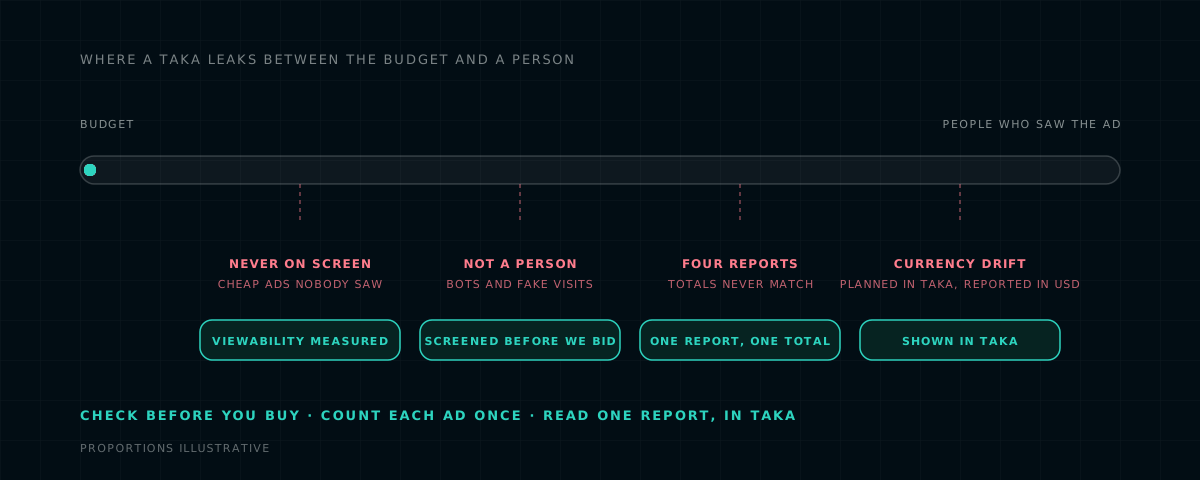
Where a taka leaks between the budget and a person, and what closes each leak. Proportions are illustrative.
Plan, buy and measure every channel from one place
AdZoic is a programmatic advertising platform built in Dhaka for the brands and agencies that sell here and across Asia. You set up a campaign once, choose where it should run, and read one report in your own currency.
WEBSITESMOBILE APPSONLINE VIDEOSOCIALSEARCH
- Every channel, one campaign. Display, rich media and video across websites and apps through the open auction, plus social, video and search campaigns on partner networks, all planned and controlled from the same dashboard. On a connected partner network, pause, budget and date changes made in AdZoic are carried through.
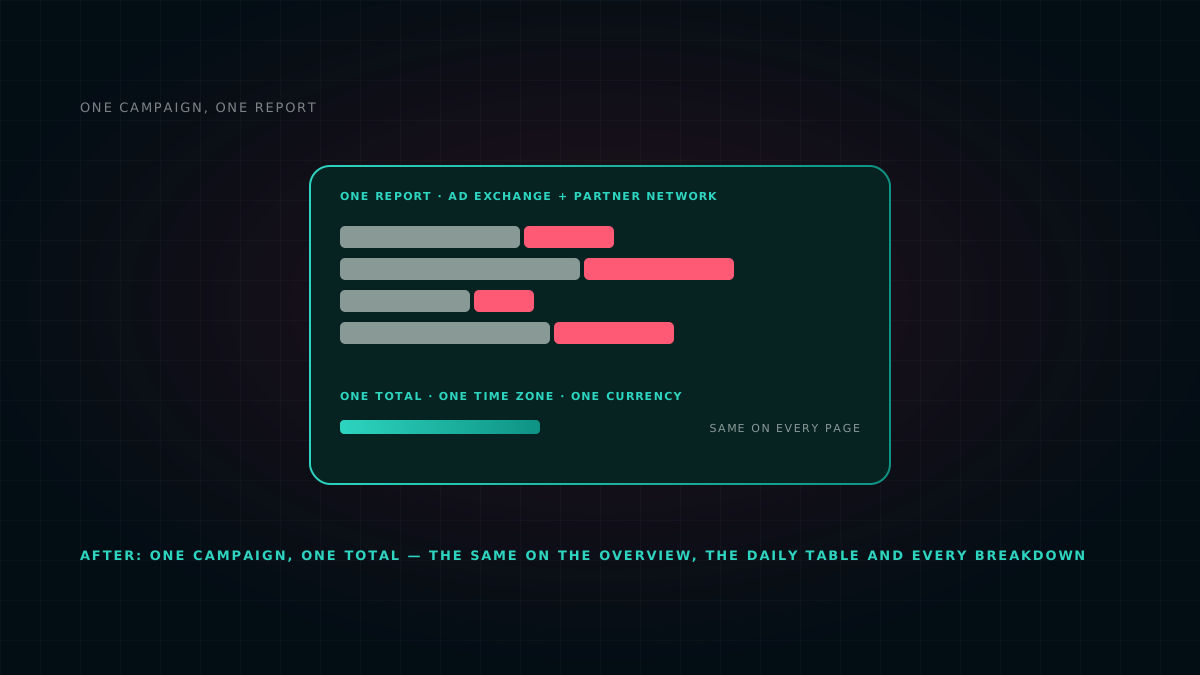
- One report, in taka. Delivery from every channel lands in a single report with one total. Our own exchange buying refreshes every few minutes; a connected partner network is pulled in every hour; a partner that can only provide files lands in the same report through an import. Spend is shown in BDT or USD, converted with dated exchange rates, so January and June are compared on the same footing. How that report is built.
- Targeting built for how Bangladesh connects. Target by city or region, by a radius around a location, by device and operating system, and by mobile operator and connection type — mobile data or Wi-Fi, and the network generation where the request carries it. Schedule ads by hour and day.
- Formats that work on phones. Standard banners, HTML5 rich media, MRAID in-app ads, VAST video and native ads. Upload once; each creative is checked before it serves.
- Quality before price. Every request is screened for invalid traffic before we bid. Viewability is measured in-house against the industry's display and video thresholds, and inventory that people do not see is cut from the plan. Privacy signals carried in a request are honoured. The standard behind every impression we report.
- Reports a CEO can read. AI-written campaign summaries explain what happened in plain language. The figures in the report come from the campaign's own data; the AI writes the explanation around them.
- Private deals. Run on private marketplace deals with selected publishers when you need guaranteed placements, alongside the open auction.
- Made for agencies. Manage many brands with separate access for each client, or run the whole platform under your own name and domain.
A seven-step plan for your next campaign
This is the plan our team uses with brands launching in Bangladesh. It works with any budget, and every step maps to a setting in the dashboard.
- Pick one business goal and one number. Awareness, consideration or sales. Then choose the number that proves it: viewable reach for awareness, cost per landing-page visit for consideration, cost per order for sales. A campaign judged on three goals is judged on none.
- Map the audience to how they connect. Dhaka, Chattogram and the rest of the country behave differently. Split by region, then by device and connection type. Phones on slower networks get lighter creatives; Wi-Fi and 4G audiences can take video.
- Write for the thumb, in Bangla first. Most of your audience will see the ad on a phone, often while scrolling. Lead with the product and the offer in the first second, keep text short, and test a Bangla version against English. Keep HTML5 files light so they load on mobile data.
- Give each channel a job. Use video on the open web and video platforms to build reach, social and native placements to start consideration, and search plus well-targeted banners to close. One campaign, three roles, one report.
- Plan around the calendar. Prices and attention swing hard around Ramadan and the two Eids, Pohela Boishakh and Durga Puja. Start awareness two to three weeks before the peak, before prices climb, and move budget to conversion as the day approaches.
- Schedule for real behaviour. Use dayparting to concentrate spend in the hours your customers are active — for many consumer brands that is the evening, on phones — and pull back overnight. During Ramadan, shift towards the hours after iftar and around sehri.
- Review weekly and cut waste. Every week, look at viewable impressions, clicks and cost by channel, region and placement. Move budget from the bottom fifth to the top fifth. Small, regular moves beat one big rethink at the end of the month.
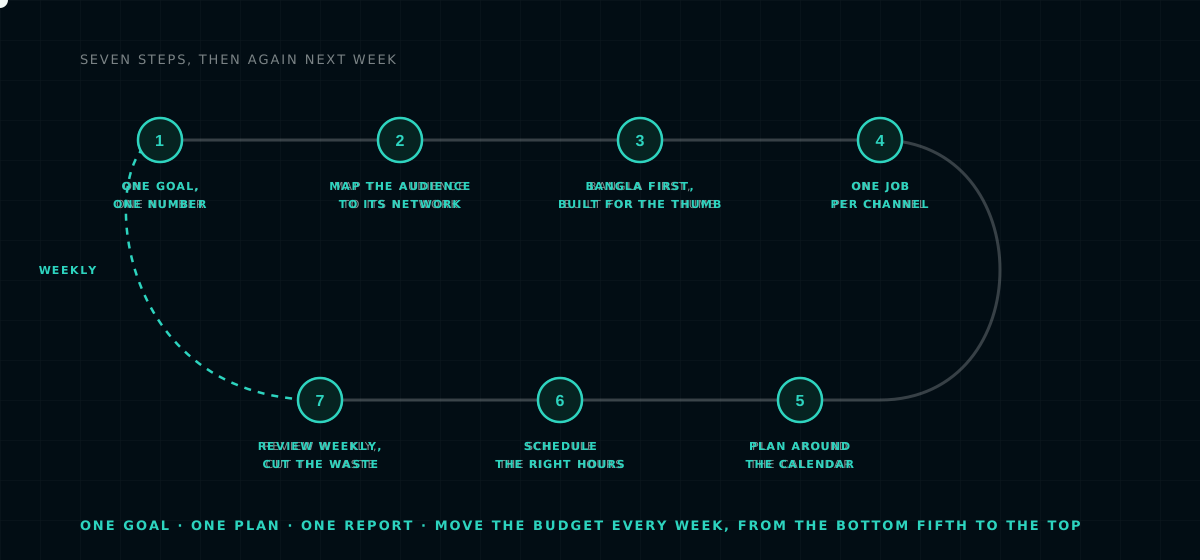
The seven steps, and the weekly loop that makes them a habit rather than a launch checklist.
Where the first taka should go
For a brand new to programmatic, this split is a sensible starting point. Treat it as a hypothesis and let the weekly review move it.
| Stage | Share | Channels | Formats | Judge it by |
|---|---|---|---|---|
| Awareness | 40% | Online video, websites, apps | Video, rich media | Viewable impressions, cost per thousand viewable |
| Consideration | 35% | Social, native placements | Image, carousel, native | Clicks, landing-page visits, cost per visit |
| Conversion | 25% | Search, websites, apps | Search ads, banners | Orders or leads, cost per result |
The Bangladesh advertising calendar
Attention and prices move with the calendar more than with anything else a planner controls. Islamic holidays fall about eleven days earlier each year, so confirm the exact dates as the moon sighting approaches.
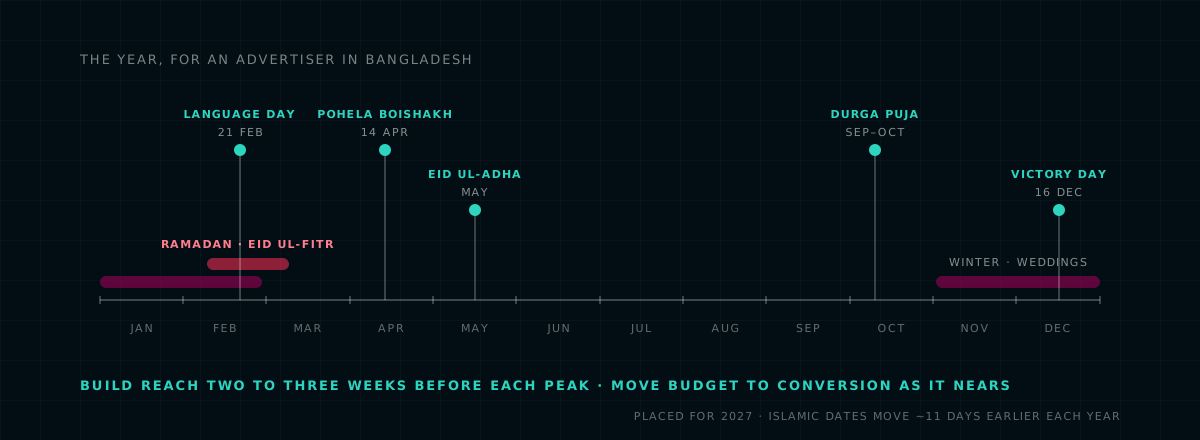
The year, placed for 2027. Build reach two to three weeks before each peak; move budget to conversion as it nears.
| Moment | When | What to do |
|---|---|---|
| Language Day | 21 Feb | Bangla-first creative; culture and education brands |
| Ramadan and Eid ul-Fitr | Feb to Mar in 2027 | The biggest retail season. Build reach early, then shift budget to conversion in the last ten days |
| Pohela Boishakh | 14 Apr | Fashion, food and FMCG. Short, colourful video |
| Eid ul-Adha | May in 2027 | Home appliances, fridges and freezers, logistics, mobile financial services |
| Durga Puja | Sep to Oct | Fashion, gifting and travel, with regional targeting |
| Winter and wedding season | Nov to Feb | Jewellery, electronics, travel and banking offers |
| Victory Day | 16 Dec | Brand storytelling and national-pride creative |
Questions we get asked
Do I have to stop working with my social media agency to use AdZoic?
No. AdZoic adds websites, mobile apps and online video to what you already run, and brings delivery from partner networks into the same report. You keep your own accounts on those networks.
Can I see campaign spend in taka?
Yes. Reports can be shown in BDT or USD, converted with dated exchange rates, so one month can be compared with another on the same footing.
How much budget do I need to start?
There is no single right figure; it depends on the goal, the channels and the season. The awareness, consideration and conversion split above is a starting point that scales with any budget. Tell us the goal and the budget you have, and we come back with a plan sized to it.
When should a Ramadan campaign start?
Two to three weeks before the peak, to build reach before prices climb, then shift budget to conversion in the last ten days before Eid. For 2027 that means starting in late January, and confirming the exact dates as the moon sighting approaches.
Run your next campaign on every screen in Bangladesh
Tell us your goal and your budget. We will come back with a channel plan and a calendar, set up in the same dashboard you will use to run it.
Every market figure in this post is quoted from the numbered source beside it, with the date each source gives; we have not produced our own estimates, and the sources differ widely on the size of the market because they define it differently. Facebook, Instagram and YouTube are named only to describe the market as those public sources report it; they are trademarks of their owners, and AdZoic is not affiliated with or endorsed by them. The budget split is a starting hypothesis, not a benchmark, and no campaign-performance claim is made. Festival dates are placed for 2027 and are approximate. Product behaviour described here is how AdZoic works in October 2026 and may change. This describes our own platform and is not advice for yours.
Sources
- Bangladesh Telecommunication Regulatory Commission figures for June 2026, reported by The Financial Express, 3 August 2026: Internet subscriber growth outpaces mobile connections in H1.
- The Daily Observer, 17 August 2026: report on the digital share of advertising spend and its drivers.
- NapoleonCat, September 2026: Social media users in Bangladesh.
- StatCounter Global Stats, September 2026: Social media stats, Bangladesh.
- Statista Market Insights figures as reported by The Financial Express, 13 February 2025: Local ad market shifting to digital media.
- Research and Markets via GlobeNewswire, 10 February 2026: Bangladesh Digital Ad Spend Business Report 2026.