Ramadan and Lebaran are the biggest advertising season of the year in Indonesia. Most brands plan them as a string of separate campaigns. This is a practical guide to planning the whole season once: build reach early, move budget to conversions as Lebaran nears, schedule around sahur and buka puasa on local time, and read it all in one report.
For a month, the rhythm of daily life changes. People wake before dawn for sahur, fast through the day, break the fast at sunset and stay up later in the evening. Then comes Lebaran (Idulfitri): holiday allowances, shopping, gifts, and for many families the journey home, mudik. Attention and spending both shift, and so does the competition for ad space.
That makes the season worth planning carefully. It also makes it easy to plan badly, one channel and one idea at a time.
Why one plan beats separate campaigns
A typical Ramadan setup looks like this: a video campaign for the brand team, a social campaign run by an agency, a search campaign for performance, and a separate push for the Lebaran sale. Each has its own budget, its own dashboard and its own idea of success. When the season ends, someone tries to add it all up.
Three things go wrong with that:
- Nobody can move money between stages. If the reach campaign is working and the sale campaign is short, the budgets sit in different places and the move takes days.
- The same people get hit from every side. Four campaigns that don't know about each other can show one person the same message far too often, while missing others entirely.
- The season can't be judged as a whole. Did the early video make the later sale cheaper? With four reports in four formats, nobody can say.
The alternative is one campaign plan for the whole season. In AdZoic, mobile apps, mobile web, online video, YouTube, Google Search, Facebook and Instagram can sit in one plan, with one budget and one set of rules, and report into one place. Each channel gets a job; the plan decides when that job matters most.
The shape of the season
Think of the season as five phases, not one flight. Islamic holidays move about eleven days earlier each year; in 2027, Ramadan falls early in the year, around February and March. Confirm the exact dates once the government's sidang isbat has set them, and build the plan around the phases rather than fixed days.
| Phase | Roughly when | Main job | Judge it by |
|---|---|---|---|
| Before Ramadan | Two to three weeks before it starts | Build reach while competition is lower | Viewable reach, cost per thousand viewable impressions |
| Early Ramadan | The first weeks | Keep reach going, start consideration | Completed views, clicks, landing-page visits |
| Late Ramadan | The last ten days or so, as holiday allowances arrive | Convert: sales, sign-ups, visits | Orders or leads, cost per result |
| Lebaran | The holiday itself | Greetings and brand, lighter spend | Viewable reach |
| After Lebaran | The return home and the week after | Re-engage people who showed interest | Return visits, cost per result |
An example shape, not a benchmark. Your category may peak earlier or later.
Build reach early, then move budget to conversions
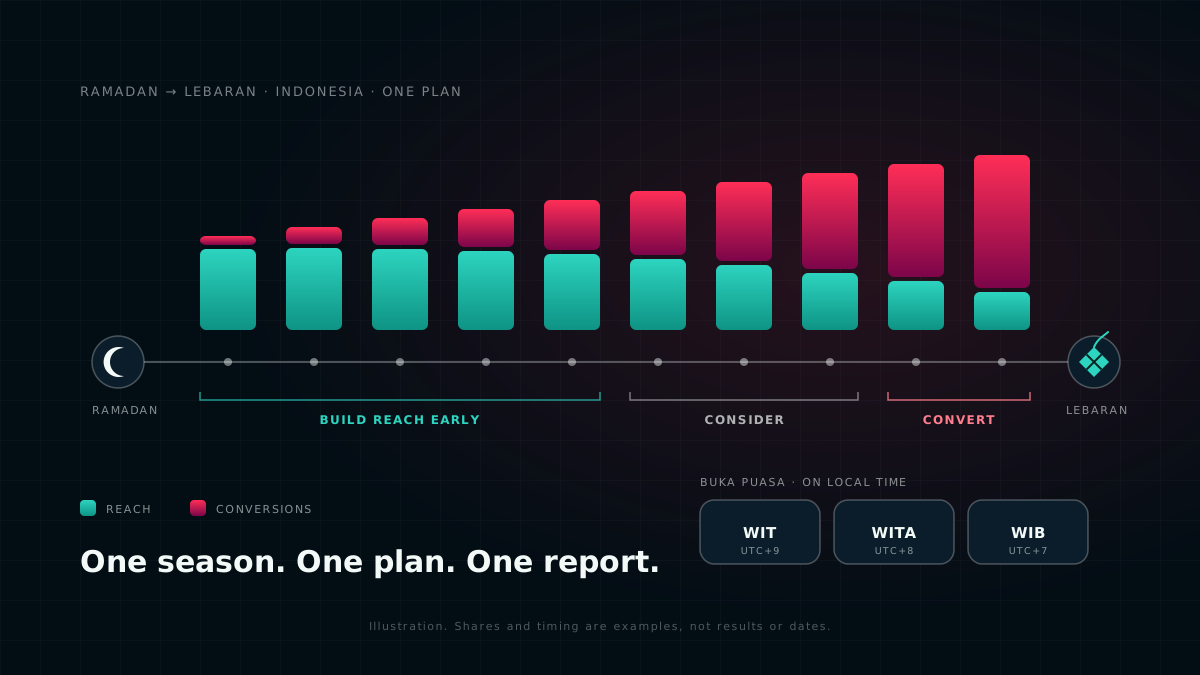
The logic is simple. People buy from brands they already know, and it is cheaper to become known before everyone else starts shouting. So the season starts with reach and ends with conversions.
- Start reach two to three weeks before Ramadan. Use online video and rich in-app and mobile-web placements to put the brand and the season's story in front of as many of the right people as possible. Judge it by viewable reach, not raw impressions.
- Add consideration as Ramadan begins. Mobile web with contextual targeting (pages about cooking, family, travel or shopping, read by the page, not by following the person), native placements and social give people a reason to look closer.
- Shift to conversions in the last ten days. This is when holiday allowances (THR) land and Lebaran shopping peaks. Move the larger share of budget to search, well-targeted banners and retargeting of people who already engaged, with frequency caps so they are not followed around.
- Let the goal steer the details. Tell AdZoic what a good result looks like (a sale, a sign-up, a visit) and the machine-learning models tune bids, budget and targeting around it through the day, explaining their moves in plain words.
AdZoic's pacing is designed to spend a budget evenly to its end date. That is what you want inside a phase, and not what you want across the season. If one budget covers the whole of Ramadan, it will spend about the same each day. To make spend rise as Lebaran nears, give each phase its own dates and budget in the plan.
Dayparting around sahur and buka puasa
During Ramadan, the day has new peaks. Phones come out at different hours, and the hours your audience is busy are not the hours of a normal month. A few moments are worth planning around:
- Sahur, before dawn. People are awake, eating and often on their phones. A short, quiet window that many brands ignore.
- Late afternoon (ngabuburit). The wait for buka puasa: browsing, planning the meal, going out to buy takjil.
- Buka puasa, at sunset. The meal itself. Attention goes to family and food, not screens, for a while.
- The evening. After the meal and evening prayers, people settle down with their phones. For many consumer brands this is the strongest window of the day.
Schedule ads by hour and day to put spend where these windows are, and pull back in the hours your customers are asleep or busy. Then let the data correct you: the hours that work for a food-delivery app are not the hours that work for a bank.
Mind the clock. Sunset does not happen at the same moment across Indonesia. It reaches Papua first and Aceh last, and the country runs on three time zones: WIB (UTC+7), WITA (UTC+8) and WIT (UTC+9). An evening schedule written for Jakarta is an hour off in Makassar and two hours off in Jayapura. If your campaign reaches more than one time zone, split it into one line per zone so each schedule follows local time, and check which time zone your report counts its days in.
Creative in Bahasa Indonesia, with English side by side
Ramadan creative works when it sounds like the season, and the season speaks Bahasa Indonesia. Write in Bahasa Indonesia first: the greeting, the offer and the button. Keep English for the audiences and categories where it is natural, such as some premium, tech or international brands, and test both rather than guessing.
In AdZoic, Bahasa Indonesia and English creative can run in the same campaign and are reported side by side, so you can see which language works for which audience without building two campaigns.
A few practical points for the season:
- Plan the creative to change with the phases. A story for the reach phase, a reason to look for consideration, a clear offer and deadline for conversion, and a greeting for Lebaran itself ("Selamat Hari Raya Idulfitri, mohon maaf lahir dan batin").
- Build for the phone. Indonesia is mobile-first. Lead with the product and the offer in the first second, keep text short and keep files light so they load on mobile data.
- Respect the fast. Some food and drink brands choose to hold appetite-heavy creative for the hours around buka puasa and the evening. It is a choice, not a rule, but it is worth making on purpose.
- Keep the offer honest. State what the person gets, until when and any limits, and follow local advertising rules, including the industry's own code, Etika Pariwara Indonesia.
Cities, radius and three time zones
Indonesia is one country across thousands of islands, and a national campaign is rarely what a brand actually needs. A retailer with stores in Greater Jakarta and Surabaya should not pay for impressions in places it cannot deliver to.
AdZoic targets by country, city or a radius around a location, such as a store, a mall or a venue. For the season, that means:
- Target where you can sell. Use cities for regional brands and a radius around stores for retail and food. Keep national reach for brands that are truly national.
- Group lines by time zone. Western Indonesia (WIB), central (WITA) and eastern (WIT) each get their own line, so dayparting and reporting follow local hours.
- Plan for mudik. In the days before Lebaran, many people travel from the big cities to their home towns, and come back afterwards (arus balik). A campaign aimed only at Jakarta in the last days before Lebaran may be aimed at people who are no longer there. Consider widening city targeting for the holiday itself, and returning to the big cities for the post-Lebaran phase.
Brand safety in a holy month
Ramadan raises the stakes for where an ad appears. A family brand's greeting next to hateful content, a scam site or a page nobody real visits is a bad look in any month, and a worse one in this one.
AdZoic checks every ad opportunity before it bids, not after the money is spent. Known invalid (bot) traffic, made-for-advertising sites, unsafe or off-brand content and low-viewability placements are filtered out up front. Two habits help on top of that:
- Choose the content you want to avoid before launch. Decide which categories don't fit your brand during Ramadan, and set them before the campaign starts rather than in the middle of the peak.
- Use context to choose where to appear, as well as where not to. Contextual targeting matches the ad to the page's topic and keywords. A recipe page before buka puasa or a travel page before mudik can be a better neighbour than a random placement at a lower price.
Cheap impressions are easy to buy in a busy season. The question is whether a person saw them, on a page you would be happy to be seen on.
Measure the whole season in one report
A season plan needs a season report. If the reach phase, the conversion phase and the partner-network campaigns each report somewhere different, you can't tell whether early reach made the later sale cheaper.
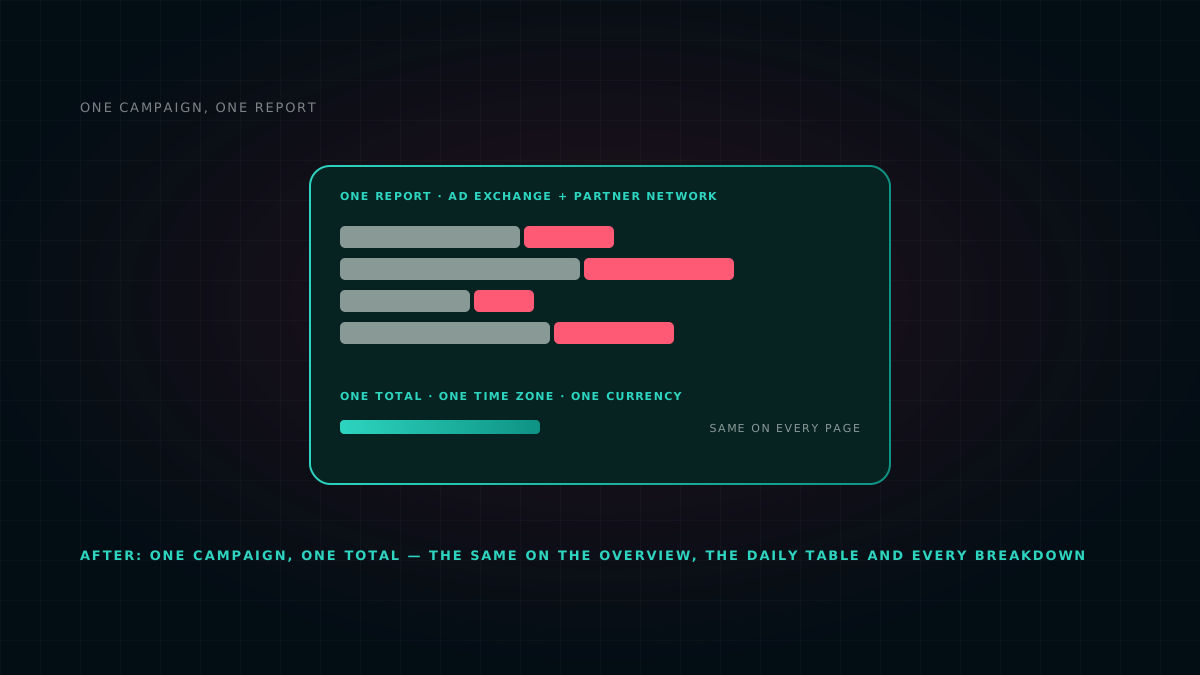
In AdZoic, delivery from every channel lands in one report with one total: the open exchange, and partner networks such as YouTube, Search, Facebook and Instagram run through your own accounts. The report keeps one reporting day and says which time zone it counts in, so "yesterday" means the same thing to everyone.
For the season, read the report in three ways:
- By phase. Set the dates to each phase and compare: viewable reach and cost in the reach phase, results and cost per result in the conversion phase.
- By creative and language. Bahasa Indonesia against English, and the Ramadan story against the Lebaran offer.
- By place and hour. Which cities and which hours delivered, so next year's plan starts from evidence instead of habit.
AI-written summaries explain what moved, what it cost and what to do next, in plain words, with the figures taken from the campaign's own data. And for advertisers in Indonesia, PT AdZoic Teknologi Indonesia can invoice in Rupiah.
Six weeks out: confirm the goal and the number that proves it, the cities, and the budget per phase. Four weeks out: creative for every phase, in Bahasa Indonesia and English, sized for the phone; brand-safety settings agreed. Two to three weeks out: reach goes live, one line per time zone. Ramadan: review weekly, move budget towards what works, shift to conversions for the last ten days. After Lebaran: read the season in one report and write down what to keep.
Plan your Ramadan season with us
Questions we get asked
When should a Ramadan campaign in Indonesia start?
Two to three weeks before Ramadan begins, to build reach before competition for ad space rises. Then move budget towards conversions in the last ten days before Lebaran. In 2027 Ramadan falls early in the year, so confirm the exact dates once the government's sidang isbat has set them.
Can I run Bahasa Indonesia and English ads in the same campaign?
Yes. Bahasa Indonesia and English creative can run in the same AdZoic campaign and are reported side by side, so you can see which language works for which audience.
How do I schedule ads around sahur and buka puasa across WIB, WITA and WIT?
Schedule ads by hour and day, and split the campaign into one line per time zone so each schedule follows local time. An evening schedule written for Jakarta is an hour off in WITA and two hours off in WIT.
Can I be invoiced in Rupiah?
Yes. Advertisers in Indonesia can be invoiced in Rupiah (IDR) by PT AdZoic Teknologi Indonesia, from our office in SCBD, Jakarta.
The phases, timing and budget shapes in this post are examples and a starting hypothesis, not benchmarks, and no campaign-performance claim is made. Ramadan and Idulfitri dates are set each year by the Indonesian government and are described here only approximately. YouTube, Google Search, Facebook and Instagram are named only to describe channels AdZoic can plan and report on through your own accounts; they are trademarks of their owners, and AdZoic is not affiliated with or endorsed by them. Product behaviour described here is how AdZoic works in November 2026 and may change. This is general guidance, not legal advice on advertising rules.