Hiring usually starts with a pile of CVs and too few hours to read them. ADZOIC Talent is our CV bank and screening platform for Bangladesh. A job seeker uploads a CV once, AI reads it and builds a profile that employers can search, and people decide who to call and who to hire.
It lives at talent.adzoic.com and describes itself as an "AI-powered talent platform" for Bangladesh. Its tagline says what it is for: "Skilled people, found for what they can actually do." This post explains how it works for job seekers and for employers, what the AI does and does not do, and how the data is handled. Everything below is taken from the product's own public pages as they read on 23 November 2026.
What it is
ADZOIC Talent is two things in one place. For job seekers, it is somewhere to put a CV once and be found for what you can do. For employers, it is a bank of profiles they can search, and a screening tool that reads every application against the job description.
As its site states in November 2026, it has "700+ professionals with searchable profiles". We use it ourselves too: AdZoic recruits for its own open positions through it.
If you are looking for work
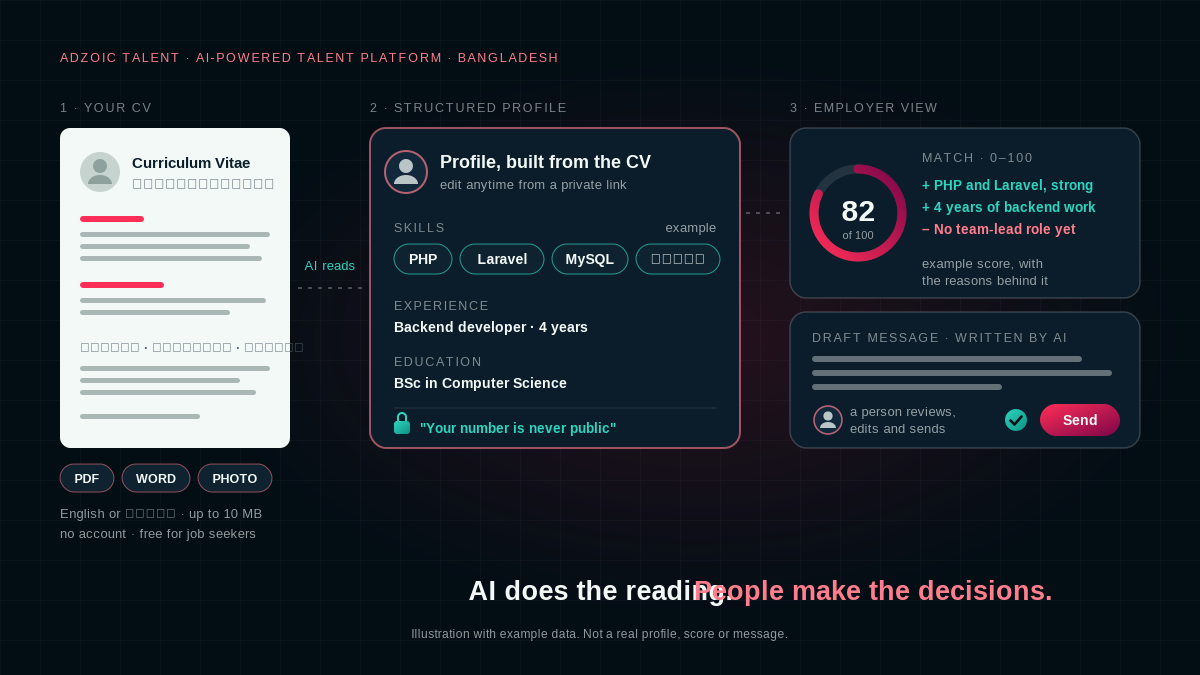
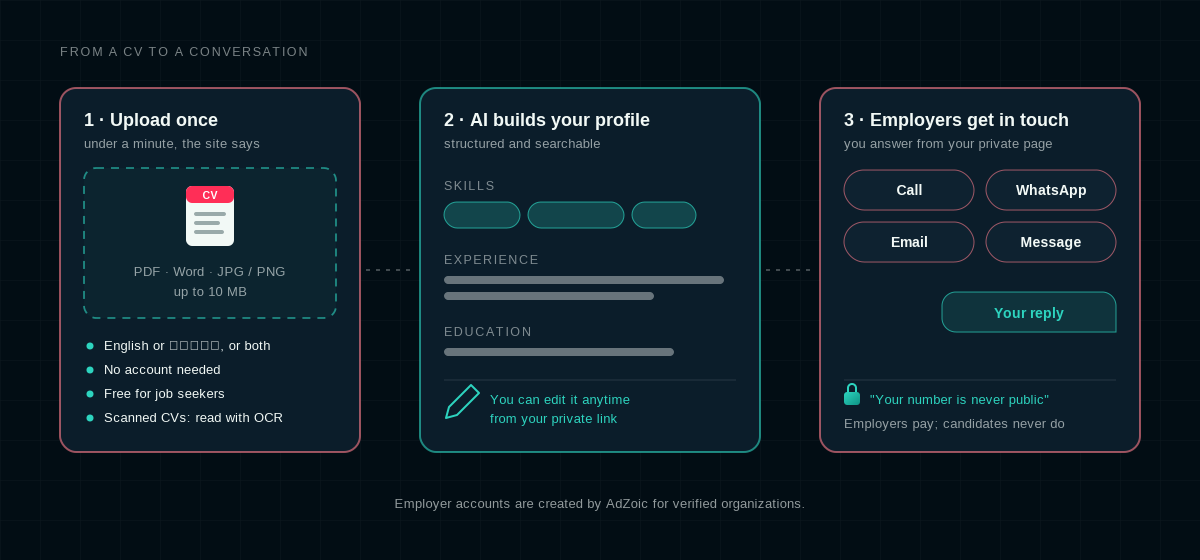
You upload your CV once, in English or Bangla, or both. You do not need an account. The file can be a PDF, a Word document (.docx or .doc) or a clear photo (JPG or PNG), up to 10 MB. Scanned CVs are read with OCR, software that turns a picture of text into text. The site says uploading takes under a minute.
AI then turns the CV into a structured profile: your skills, experience and education, laid out so they can be searched. You can edit the profile anytime from a private link. That matters, because AI can misread a CV. Check your profile after you upload, and correct anything it got wrong.
Employers reach you by call, WhatsApp, email, or messages that you answer from your private page. The site is direct about your phone number: "Your number is never public."
And it is free for job seekers. In the site's words: "Employers pay; candidates never do."
If you are hiring
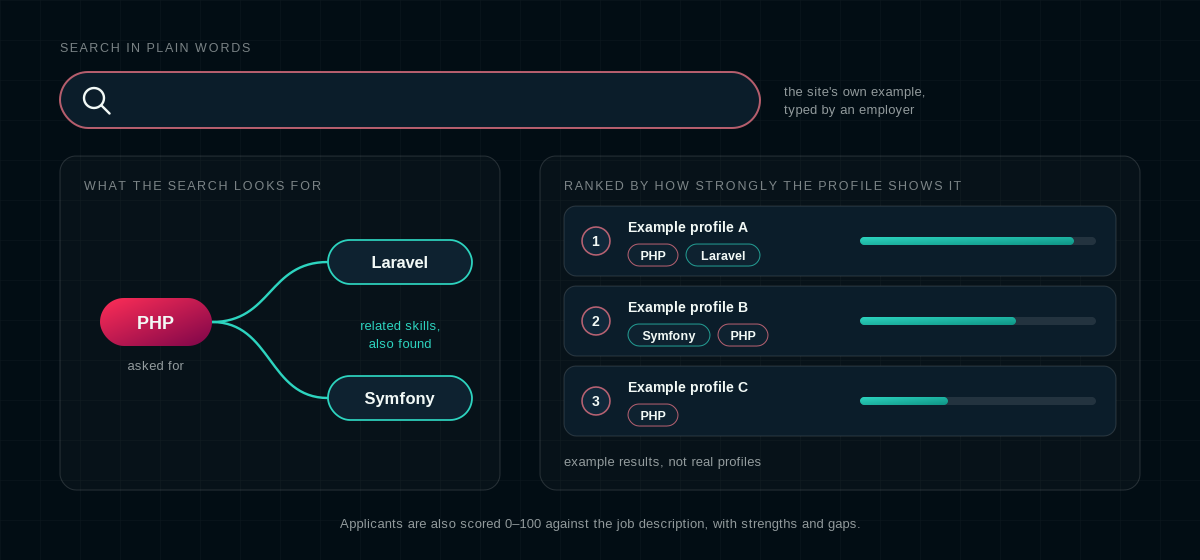
You search in plain words, the way you would describe the job to a colleague. The site's own example is "Need someone who writes PHP really well". According to the site, that search also finds Laravel and Symfony developers (both are PHP frameworks), ranked by how strongly each profile shows the skill.
- A score with its reasons. Every applicant is scored 0–100 against the job description, with the specific strengths and gaps behind the number. You see why, not only how much.
- One contact log. Every contact is logged, so people on the same team do not double up on the same candidate.
- Personal accounts. Each person has their own account with a role, can sign in with Google, and there is a record of who viewed which profile.
Employer accounts are not self-service. They are created by AdZoic for verified organizations. To ask for one, write to hello@adzoic.com.
The match score is the AI's reading of a CV against a job description. It can be wrong: a CV may leave a skill out, or the AI may misjudge one. Read the reasons, read the CV and talk to the person. The score is not a hiring decision.
What the AI does, and what it does not
The site puts it in one line: "AI does the reading. People make the decisions." In practice, the AI has three jobs:
- It reads CVs and builds a profile from each one.
- It suggests matches between profiles and a job, with a score and the reasons behind it.
- It drafts messages. Replies and letters are drafted for a person to review, edit and send.
And there are two things it does not do. It does not send anything by itself: as the site says, "no email is sent without a person clicking Send". And it does not decide who gets hired.
The reasoning is simple. Reading is the slow part of hiring, and on a busy day a good CV gets skimmed. So the AI reads every CV and shows its reasons. The judgement, the conversation with the candidate and the decision stay with people. Like any AI, it can make mistakes, which is why the reasons are shown and why a person reviews every draft before it goes out.
Who can see a profile
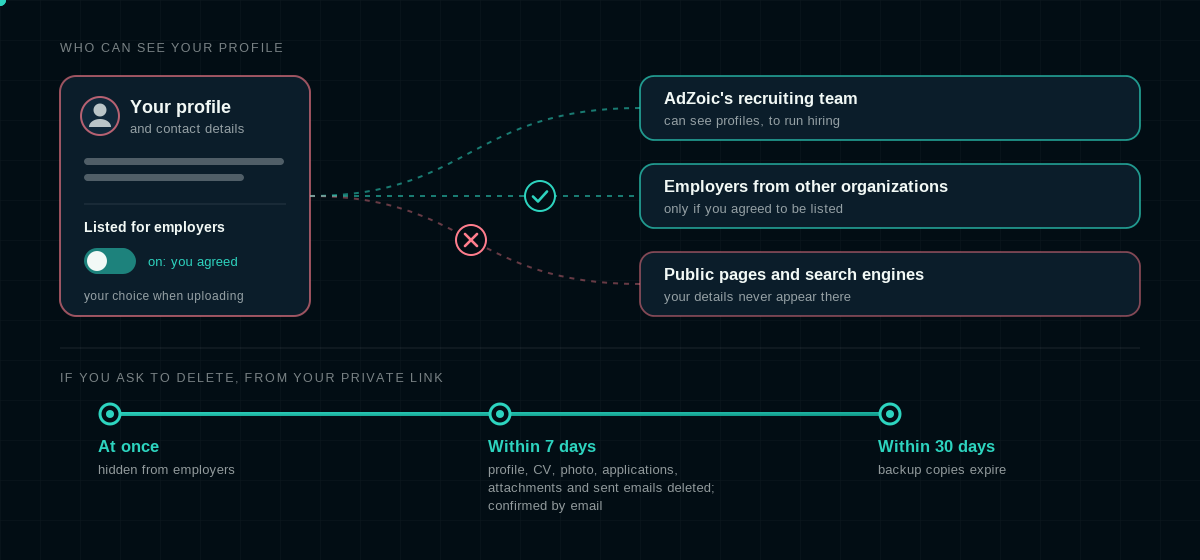
The product's privacy page sets out who sees what:
- AdZoic's recruiting team can see profiles, in order to run hiring.
- Employers from other organizations see a profile and its contact details only if the person agreed to be listed when uploading.
- Applications sent to AdZoic stay internal, unless the person opts in.
- Public pages and search engines never show a person's details.
If you want your data deleted
You ask from your private link. The profile is hidden from employers at once. Then, within 7 days, AdZoic deletes the profile, the CV, the photo, applications, attachments and the emails sent, and confirms it by email. Backup copies expire within 30 days.
Where the data goes
We would rather be exact here than reassuring. ADZOIC Talent uses outside services to do its work, and its privacy page names them:
- Anthropic (Claude) reads CVs to build profiles and match scores, and drafts letters for a person to review.
- Postmark delivers email.
- Cloudflare provides the encrypted connection.
- Google is used only for employers who sign in with Google.
On storage, the privacy page says: "Your data is stored on ADZoic's own server, not sold or rented to anyone." So there are two separate facts. The reading is done by an outside AI provider, as a service. The data is stored on AdZoic's own server. This is a different setup from the private AI our team uses for its own work, which is a separate product.
For protection, the page lists HTTPS on every page, encrypted storage for data and backups, personal employer accounts with roles and automatic sign-out, and a record of every profile view and contact that administrators can review. The full wording is on the ADZOIC Talent privacy page. That page, not this post, is the one to rely on.
CV bank: a store of CVs that employers can search. Structured profile: a CV broken into labelled parts, such as skills, experience and education. OCR: software that reads the text in a photo or a scan. Match score: a number from 0 to 100 for how closely a profile fits a job description, as the AI reads it. Private link: a personal web address for your own profile, which you do not share.
Questions we get asked
Is ADZOIC Talent free for job seekers?
Yes. The site says employers pay and candidates never do. You upload your CV once, and you do not need an account.
Can I upload my CV in Bangla?
Yes. You can upload in English or Bangla, or both, as a PDF, a Word file or a clear photo, up to 10 MB. Scanned CVs are read with OCR.
Does the AI decide who gets hired?
No. The AI reads CVs, suggests matches and drafts messages. People make the decisions, and the site says no email is sent without a person clicking Send.
Who can see my profile and my phone number?
AdZoic's recruiting team can see profiles to run hiring. Employers from other organizations see your profile and contact details only if you agreed to be listed when you uploaded. Your details never appear on public pages or in search engines.
How do I delete my profile?
Ask from your private link. The profile is hidden from employers at once. Within 7 days AdZoic deletes the profile, CV, photo, applications, attachments and emails sent, and confirms by email. Backup copies expire within 30 days.
Which AI reads the CVs?
The privacy page names Anthropic's Claude, used as an outside service to read CVs, build profiles and match scores, and draft letters for review. The data is stored on AdZoic's own server.
How does an employer get an account?
Employer accounts are created by AdZoic for verified organizations. Write to hello@adzoic.com to request one.
Looking for work? Upload your CV at talent.adzoic.com. Hiring? Write to hello@adzoic.com and tell us about your organization.
The illustrations in this post are drawings with example data, not screenshots, real profiles or real scores. Figures, quotations and features are as stated on talent.adzoic.com and its privacy page on 23 November 2026. Features, availability and terms can change, and the product's own pages are the current source. AI output can be wrong and should be reviewed by a person; a match score is not a hiring decision. Nothing here promises a job, an interview or a hire. Anthropic and Claude are trademarks of Anthropic, PBC; Google is a trademark of Google LLC; WhatsApp is a trademark of WhatsApp LLC; other names are trademarks of their owners. They are named only to describe the services the product uses and the ways employers can get in touch; naming them does not imply endorsement.