adZoic now has its own private AI. It runs on our own server, it knows the language of advertising, and the team uses it for everyday work: to write, to analyse, to answer questions from our own documents, and to turn a request into a finished file in one click.
AI assistants have become part of everyday work almost everywhere. But for a company that handles campaign plans, client briefs and proposals, one question matters more than any feature: where do our words go?
So we built our own. Not a subscription to someone else's chatbot, but an AI that lives on adZoic's own server, set up for the work we actually do.
What "our own private AI" means
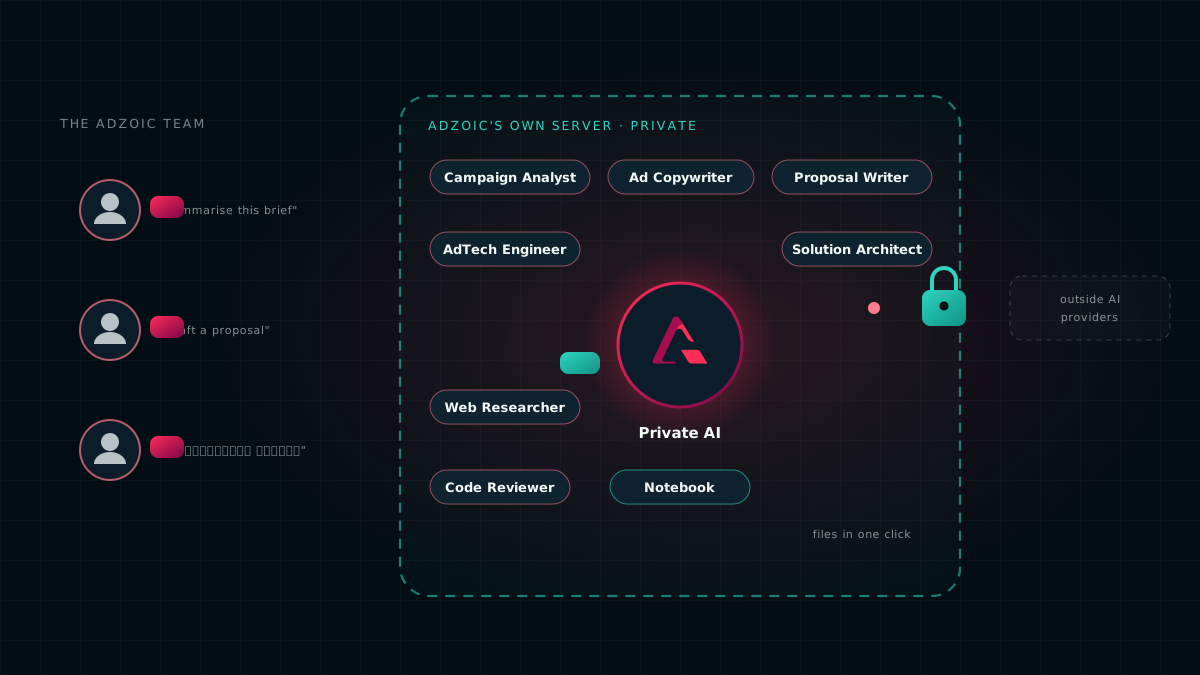
Let us be precise, because precision is the point. We did not train a brand-new AI model from scratch: that is rare and costly, and like most companies, we build on open models. We run leading open AI models (models whose makers publish them so that anyone can run them on their own machines) on our own server. We host them, configure them, and build our own assistants, knowledge and tools on top.
The result is an AI that is ours in the way that matters: it runs where we decide, works the way we set it up, and keeps our work with us.
Private by design
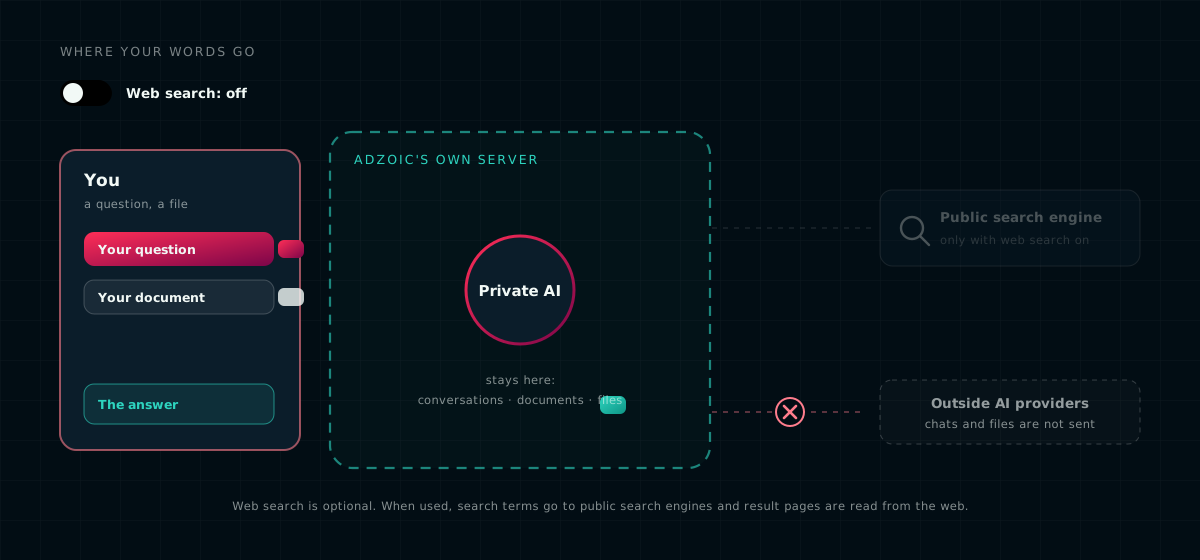
Conversations, uploaded documents and generated files are stored and processed on adZoic's own server. They are not sent to outside AI providers.
There is one honest exception, and we would rather say it than hide it. The assistant can now search the web, which is useful when a question needs something recent. Web search is optional, message by message. When someone uses it, the search terms are sent to public search engines and the result pages are read from the web; chats and documents are not shared. It is new, and we are still tuning it.
Eight specialists, one place
A general assistant is good at many things. A specialist is better at one. Alongside the everyday chat assistant (for writing, summaries, analysis and coding help), the team has eight specialist assistants. Pick one to see what it does:
Campaign Analyst
Reads the campaign figures you give it and explains, in plain words, what went up, what went down and what is worth a closer look.
Here are last week's results. What changed, and what should I check first?A short read-out of the changes, and the questions worth asking next.
Ad Copywriter
Writes ad copy in different lengths and tones, so the team starts from several options instead of a blank page.
Five headlines for a banking app, friendly, under 30 characters.Options to choose from and edit, never copy that goes out unchecked.
Proposal Writer
Turns a brief into a structured proposal or a quotation, laid out and ready for review.
Draft a proposal for a three-month video campaign from this brief.A draft proposal or a branded PDF quotation that a person checks before it is sent.
AdTech Engineer
Helps write, debug and test code for our ad tech systems, and can run Python code itself to check that it works.
This bid-request parser fails on empty fields. Fix it and test it.Fixed, tested code for an engineer to review before it ships.
Solution Architect
Helps plan how systems fit together, from a rough idea to a design outline.
Outline how a report link should handle expiry and revoking.A design outline with the parts, the steps and the trade-offs.
Code Reviewer
Reads code and points out likely bugs, risks and simpler ways to write it.
Review this function for bugs and edge cases.A list of findings, most important first, for an engineer to decide on.
Notebook
Answers only from the documents you give it, and shows where each answer came from.
From these three files: which channels did we plan for Eid?An answer with numbered sources you can open and check.
Web Researcher
Looks things up on the web for every question and answers with its sources, for when something recent matters.
Find recent public reports on mobile advertising in Indonesia, with links.A short summary with links to the pages it read. Its search terms go to public search engines.
The examples above show the kind of thing each assistant is for. Like any AI, they can get things wrong, which is why a person reviews what they produce before it is used.
Ask your own documents
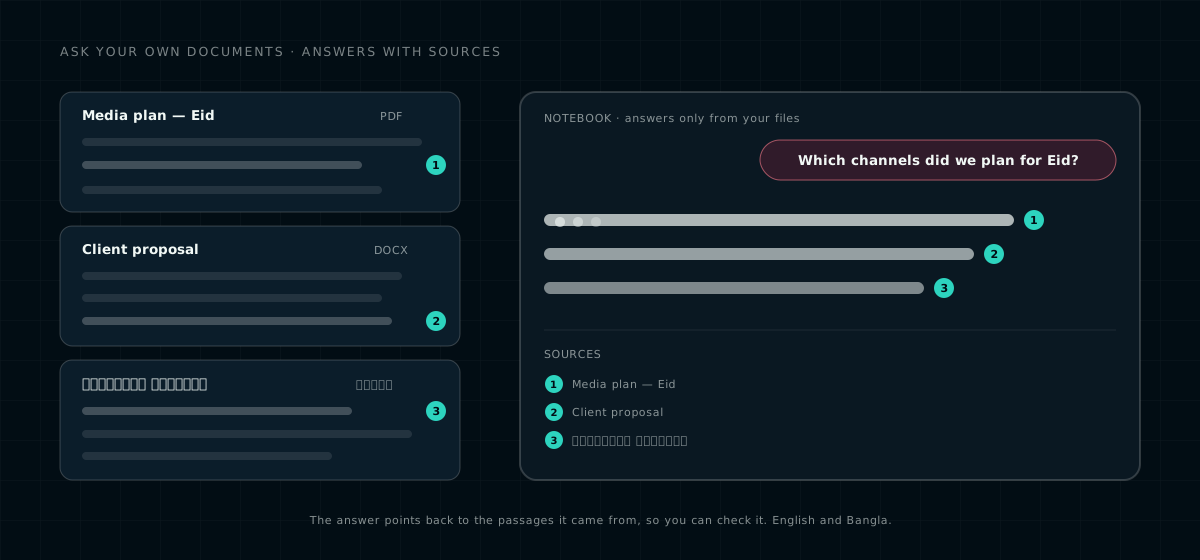
Give the assistant your own files, a media plan, a proposal, last month's report, and ask questions about them. Answers come back with references, pointing to where in your files they came from, so you can check them instead of taking them on trust.
It works in English and Bangla, which matters for a team that works in both. And there is a built-in AdTech knowledge base: a glossary of programmatic advertising terms and formulas, so "what is the difference between CPM and eCPM?" gets a clear, consistent answer.
From a request to a finished file
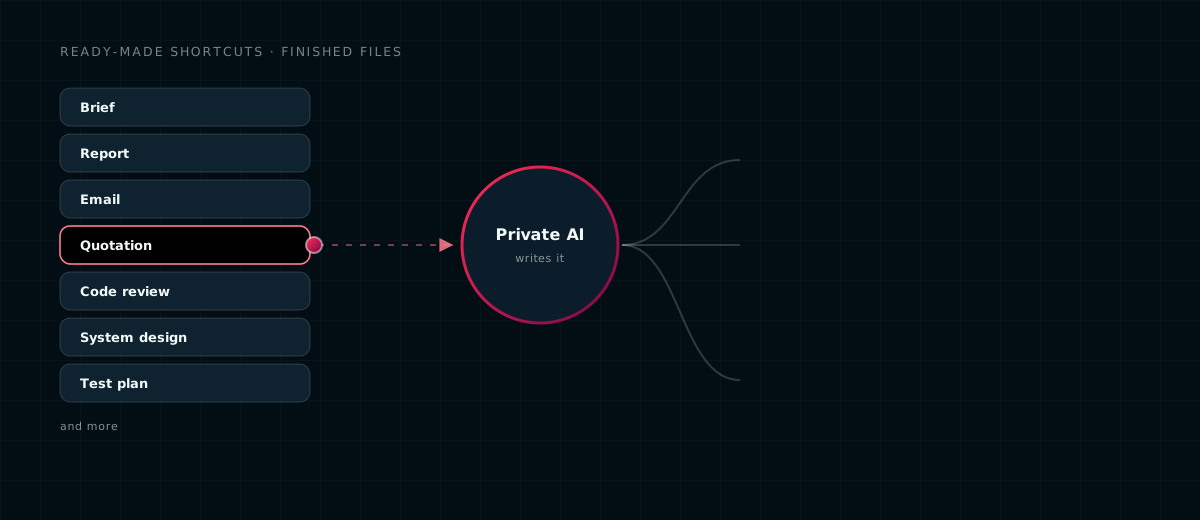
A lot of work ends in a file. So the assistant does not stop at text: in one click it produces a branded PDF quotation or report, an Excel workbook with the charts already in it, or a chart preview to check before sharing.
Common jobs have ready-made shortcuts: briefs, reports, emails, code reviews, system designs, test plans and more. Start one, fill in the details, and the assistant knows what shape the result should take.
Quotations the assistant creates are drafts. A person checks every one before it reaches a client, and nothing the AI writes is a binding offer.
Fast enough to keep up
An assistant you have to wait for is one you stop using. For typical questions, the first words of an answer usually appear in about two to three seconds. That is from our own measurements, not a promise: longer questions, big documents and web searches take more time.
Who can use it
Today it is for the adZoic team. Everyone signs in with their company Google account, and work is organised into team workspaces with roles, so people see what they should. It lives at chat.adzoic.com, and access is invite-only.
What this means for you
- Faster turnarounds. Briefs, proposals and reports start from a solid draft, so our team spends its time on judgement, not typing.
- Your material stays with us. Documents the team works on with the assistant are processed on adZoic's own server, not handed to an outside AI service.
- Consistent answers. The same glossary and the same specialist assistants across the team, so the same terms mean the same thing across the team.
- People still sign off. AI speeds up the first draft. A person owns the result.
What is next
These are planned, not live yet:
- Answers grounded in live campaign data, for quotations and forecasting.
- More automation for AdOps and Sales, taking routine steps off people's plates.
- Desktop and mobile apps, so the assistant is wherever the team is.
AI model: the engine that reads a question and writes an answer. Open model: one whose makers publish it, so anyone can run it on their own computers. Private AI: an AI that runs on your own server, so your conversations and files stay there. Specialist assistant: the same AI, set up with instructions and knowledge for one kind of job. References or sources: pointers to where in your documents an answer came from.
Questions we get asked
Did adZoic build its own AI model?
We did not train a model from scratch. We run leading open AI models on adZoic's own server, and we host, configure and build on them ourselves. That is what makes it our own private AI.
Are our conversations and documents sent to outside AI companies?
No. Conversations, uploaded documents and generated files are stored and processed on adZoic's own server and are not sent to outside AI providers. The one exception is optional web search: when someone uses it, the search terms are sent to public search engines and the result pages are read from the web; chats and documents are not shared.
Can clients use it?
Not directly today. It is invite-only for the adZoic team. Clients benefit through faster briefs, proposals and reports, which our team still checks before anything is sent.
Does it work in Bangla?
Yes. You can ask questions about your own documents in English or Bangla and get answers with references to where they came from.
Are the quotations it makes final?
No. Generated quotations are drafts. A person checks every one before it goes to a client.
Want to see what it means for your campaigns? Talk to us.
The illustrations in this post are drawings, not screenshots. The response time quoted is from our own measurements on typical questions and is not a guarantee. AI can make mistakes; outputs are reviewed by people before they are used, and generated quotations are drafts, not offers. Planned features may change. Google is a trademark of Google LLC, mentioned only because the team signs in with company Google accounts.