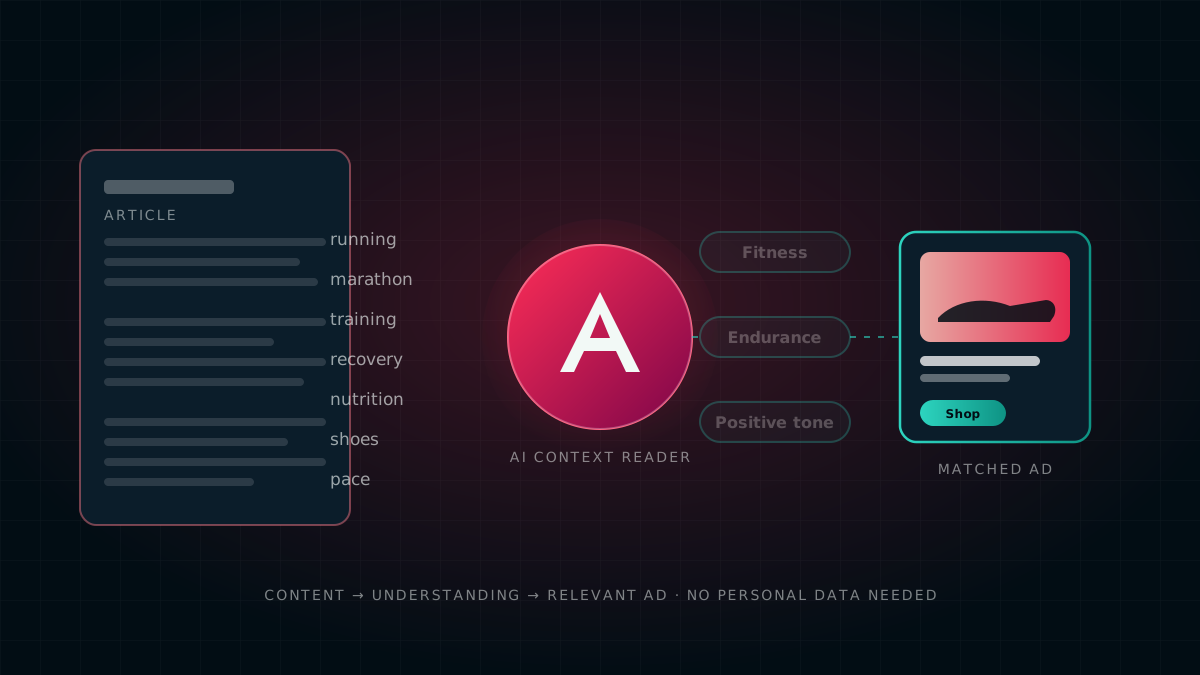
Contextual targeting is the oldest idea in advertising: put the ad next to the thing it's about. What's new is that a machine can now read the page — understand its topic, its tone, even the pictures — in the few milliseconds before an ad loads. This is a plain-English tour of how that works, what the public research actually says, and the thinking behind how we do it at AdZoic.
Why this matters now
For fifteen years most digital ads were aimed at people — using third-party cookies and device IDs to follow you across sites and build a profile. That approach is shrinking, and not by choice:
- Apple's Safari and Mozilla's Firefox have blocked third-party cookies by default for years — together a large share of browsing, and an even larger share on iPhone-heavy markets.
- Apple's App Tracking Transparency (2021) made cross-app tracking on iOS opt-in; publicly reported opt-in rates have stayed low — commonly cited in the mid-20s to low-30s percent range across industry trackers.
- Google has repeatedly reshaped its Chrome cookie plans, and regulators — GDPR in Europe, India's DPDP Act, and a growing list of Asian privacy laws — keep raising the bar for consent.
Whatever the final shape of the rules, the direction is one-way: you can rely less on knowing who someone is. Contextual targeting sidesteps the whole problem. It doesn't need to know you at all — it only needs to understand the page you chose to open.
Audience targeting asks "who is this person?" Contextual targeting asks "what is this person paying attention to right now?" — and the second question is answered by the content itself, with no personal data required.
What the research says
We're careful with numbers on this site, so here is what is genuinely on the public record — named, so you can look it up — rather than the tidy "3× lift" claims that float around ad-tech decks.
- Attention and recall. A widely-cited neuroscience study commissioned by GumGum with Spark Neuro (2020) found ads that matched the surrounding content produced measurably higher engagement and memory encoding than mismatched ads, and were rated more favourably. Directionally, this is consistent with decades of psychology on congruence: things that fit their surroundings are processed more easily and remembered better.
- Relevance without identity. IAB Europe and several verification vendors (IAS, DoubleVerify) have published buyer surveys since 2022 in which a majority of advertisers say they are increasing contextual investment as identifiers fade — treating it as a primary strategy, not a fallback.
- Consumers prefer it. Surveys from IAS ("The Context Effect", 2021 onward) report that a clear majority of consumers say ads matching the content they're viewing feel more relevant and less intrusive than ads that follow them around.
- Efficiency. Because contextual buying doesn't pay for third-party data segments, the CPMs are typically lower than audience-targeted equivalents in the open market. How much lower depends entirely on the category and the inventory — which is why we don't put a single number on it.
Read those honestly: the evidence says contextual works and is preferred, not that it is magic. It's strongest for awareness, consideration and brand outcomes, and for reaching people who can't be tracked. For late-funnel "buy again" moments, first-party data and retargeting still earn their keep — which is why you don't have to choose.
The methods: how a machine "reads" a page
Early contextual targeting was keyword matching — an ad for running shoes appears wherever the word "running" shows up. It was cheap and it was crude: "running" also appears in running late, running a company, and the running of the bulls. Modern AI contextual targeting is several methods layered together:
1. Language understanding, not word spotting
Natural-language models read whole sentences and paragraphs, so "Chelsea" near "Arsenal" and "fixture" is football, while "Chelsea" near "gallery" and "brunch" is a neighbourhood. In technical terms the model turns text into embeddings — long lists of numbers that place similar meanings near each other — so a page about marathon training sits close to endurance sport even if it never uses those words. That's how the animated banner above turns "running, marathon, recovery, pace" into Fitness and Endurance.
2. Topic classification against a shared taxonomy
The understood meaning is mapped onto a standard content taxonomy — the industry uses the IAB Tech Lab's, which has hundreds of tiers (Sports → Running → Marathon). A shared taxonomy is what lets an advertiser say "buy Automotive → Electric vehicles" and have every publisher and platform mean the same thing. How our own engine does this — and why most of the work happens before the auction rather than during it — is in how we rebuilt our context engine.
3. Sentiment and tone
Two pages can share a topic and be opposite environments. "Airline launches new route" and "airline grounded after safety failure" are both Travel → Air travel. Sentiment models score the emotional tone so a brand can ask to appear next to the first and not the second — a big part of why contextual and brand safety are really the same discipline.
4. Beyond text: images, video and audio
Pages aren't only words. Computer-vision models describe what's in the pictures; speech-to-text plus language models transcribe and understand video and podcasts, scene by scene. That's what lets contextual targeting reach into streaming TV, YouTube-style video and audio — channels where a "keyword" barely exists.
5. Doing it in time
All of this has to fit inside a real-time auction that lasts about a tenth of a second. In practice pages are analysed and scored ahead of time, the results are cached, and at bid time the DSP is doing a fast lookup rather than reading from scratch. New or fast-changing pages get read on first sight and the score is reused for everyone after.
Someone in Jakarta opens an article on marathon recovery. In under 10 ms AdZoic sees the page's cached context — Sports · Running · Endurance, positive tone, safe environment — checks that against a sportswear brand's plan, and bids for the running-shoe ad. Nothing about the reader was needed. If the same reader opens a page about a flight disaster, the same brand's plan says "no thanks" and no bid is made.
The philosophy behind how we do it
Methods are table stakes; the choices around them are what differ. These are ours.
- Read the moment, not the person. We'd rather understand a page really well than know a lot about someone. It's better for the reader, it doesn't break when a browser changes policy, and it's honest — an ad next to relevant content is transparent to everyone about why it's there.
- Context first, identity as an add-on. Contextual is the base layer of every plan. Where a customer brings their own first-party data we layer it on top — never the other way round.
- Relevance and safety are one model, not two products. The same understanding that says "this page is about running" also says "this page is about a tragedy." We use it for both, so brand safety isn't a bolt-on you pay extra for.
- Built for Asia's languages. Most contextual engines were tuned on English. Ours has to read Bangla, Hindi, Bahasa and the region's mixed-script, code-switching pages — that's where a lot of the real engineering effort goes, and it's why we build here.
- Prove it on your goals. We label demos as demos and don't publish invented lift numbers. The honest test is a live campaign measured against your own baseline — that's what a demo with us actually is.
Where it's heading
Three things are changing fast. Large language models are making page understanding sharper and cheaper, so the gap between "keyword" and "meaning" is closing for good. Multimodal models are bringing the same depth to video and audio, so contextual is becoming a true cross-screen method. And privacy law across Asia is converging on consent-first rules, which pushes the industry towards signals that never needed consent in the first place. Contextual isn't a retreat from precision — it's precision aimed at the right thing.
Want to see it read your category? Request a demo — or start with the basics in contextual vs. audience targeting.
Public references named above: GumGum × Spark Neuro contextual neuroscience study (2020); IAS "The Context Effect" consumer research (2021–); IAB Europe / IAS / DoubleVerify buyer surveys on contextual investment (2022–); IAB Tech Lab Content Taxonomy; Apple App Tracking Transparency (iOS 14.5, 2021); GDPR (EU) and India's DPDP Act (2023). We deliberately quote directions and ranges rather than single "lift" figures, because results vary by category and inventory — ask us for numbers from a live test on your goals.