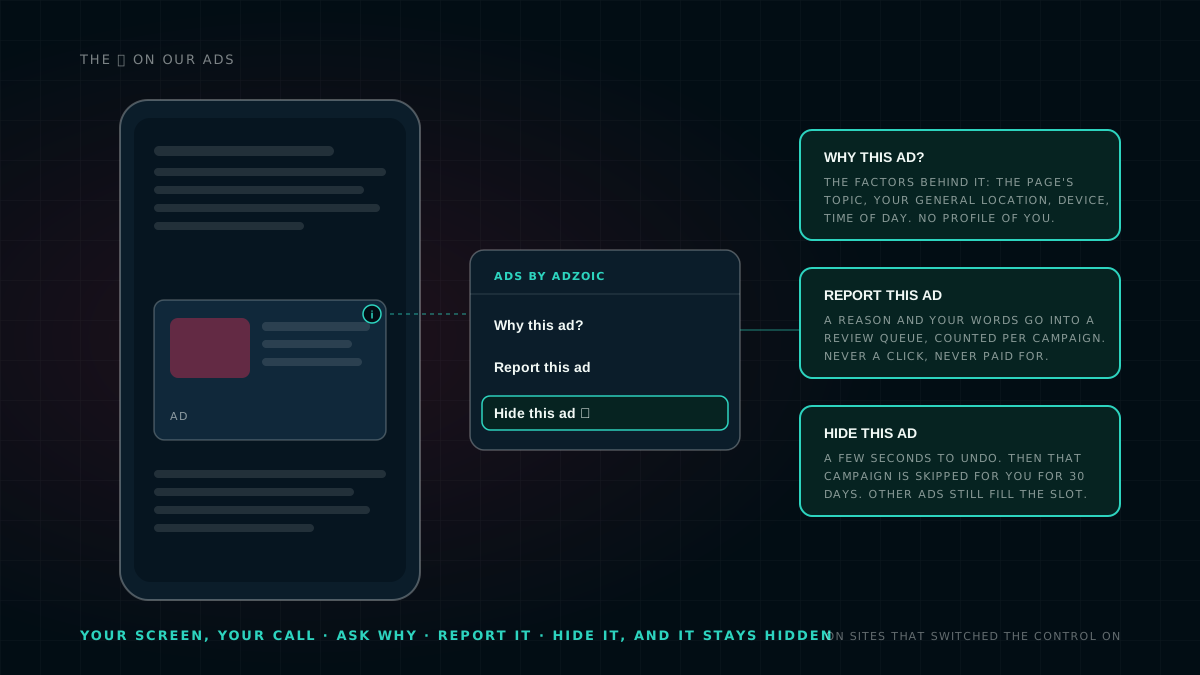
Some of the ads we serve carry a small mark in the corner. Tap it and a menu opens with three choices: Why this ad?, Report this ad, and Hide this ad. Most people will never tap it, and that is fine. But if you do, you deserve to know exactly what happens next — including what the button cannot do. This post is that explanation, in plain words.
What the mark is
The mark is one small icon that our web tag draws in the publisher's page, in the ad's top corner — outside the ad itself. That placement is the point. An ad cannot cover the mark, cannot fake one, and cannot turn a tap on it into a click on the ad, because the mark lives in the page and the ad lives in its own box. The menu's header says who served the ad: Ads by AdZoic. So when you see the mark, you know which company put the ad there, and you have somewhere to go.
Why this ad?
The first choice opens a page that lists the factors behind the ad: your general location, worked out from your connection rather than from anything you typed; the content and category of the page you are on; the kind of device you are using; and the time of day, because advertisers often schedule their ads. It also says what we do not do — we do not sell personal data to advertisers — and links to the report form.
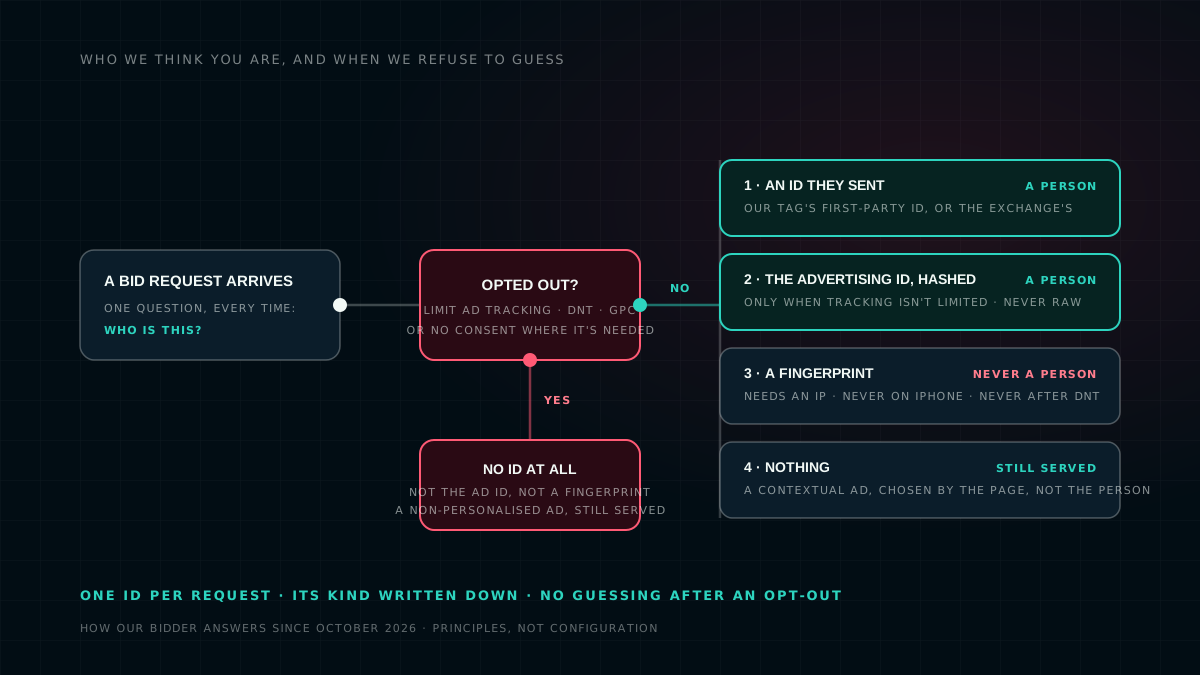
An honest limit: today that page gives the same general explanation for every ad. The explanation we want to give is specific — this campaign chose this page because of its topic, or you are seeing it because you visited the advertiser's site last week — and that is what we are building next. For how we decide who you are in the first place, read Who we think you are, and when we refuse to guess; for how a campaign chooses content, read DeepContext.
Report this ad
The second choice opens a short form. You pick a reason — misleading, inappropriate, repetitive, irrelevant, broken, or something else — and can add your own words. No account, name or email is asked for. The report goes into a queue our team reviews, and it is counted against the campaign and the creative it was about, so a campaign that collects an unusual number of reports stands out and is taken up with its advertiser. A report is never a click. It cannot earn anyone money, and it cannot cost the advertiser a click fee.
Hide this ad
The third choice collapses the ad in the page behind a short notice, Ad hidden · Undo. For a few seconds nothing leaves your browser, so a slip of the thumb costs nothing. If you let it stand, one signal is sent to us — “hidden” — and from then on that campaign is skipped for you at bid time, beside the frequency cap, for 30 days. Other campaigns still fill the slot, so the page is not left with a hole and the site still earns from it.
Two limits, stated plainly. The hide uses the same identity the frequency cap uses, and nothing more: no new tracking is started, and no cookie is set to make it work. And if we cannot recognise your browser at all — which is the case for many readers, by design — the hide holds in that browser only. That is why the button says Hide and never Never show again.
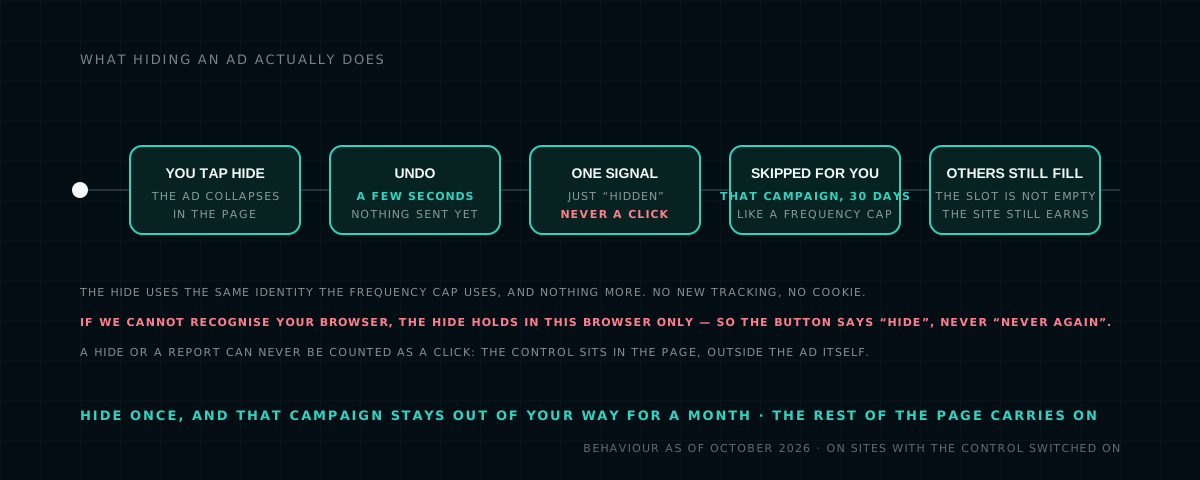
What a hide does, step by step, and the two limits that come with it.
Which ads carry the mark
Not every ad we serve carries the control, and the order of the rules matters.
- A brand's own rules win. Some advertisers forbid any third-party mark on their ads. For them there is nothing at all — no logo, no mark, no menu — on every site, whatever else is switched on.
- Then the publisher decides. On a site that uses our own tag and has switched the control on, the mark opens the full menu. Publishers turn it on site by site, and we are rolling it out that way.
- Everything else carries the plain mark. Ads we bought on an exchange, and sites that have not switched the control on yet, show the mark without a menu: who served the ad, and nothing more, for now. Extending the control to exchange-bought ads is designed and not yet built.
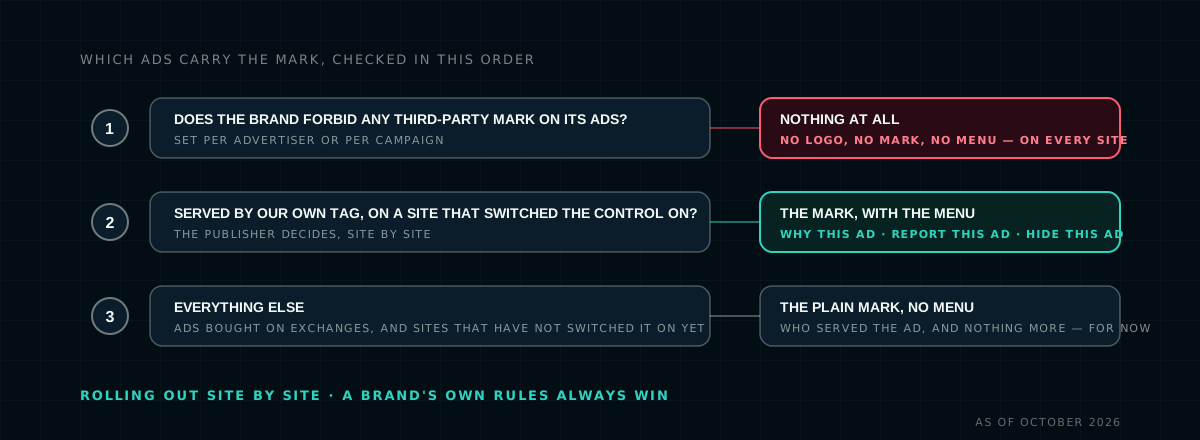
Which ads carry the mark, checked in this order.
What it can never do
| Never | Why |
|---|---|
| Count as a click | The control sits in the page, outside the ad, where the ad's click tracking cannot see it |
| Start new tracking | A hide uses the identity the frequency cap already uses, and nothing more |
| Set a cookie | The hide is sent as one signal; a note in the browser's own storage is the only local trace |
| Change what anyone else sees | A hide is yours alone; it does not touch the campaign for other readers |
| Override a brand's rules | An advertiser that forbids marks gets none, on every site |
| Promise “never again” | Without a recognisable browser the hide is local, so the button never claims more than it can keep |
Why we built it
An ad platform has three customers, and one of them is never in the room: the person looking at the screen. Advertisers get reports, publishers get revenue, and readers usually get nothing but the ad. The mark is the smallest thing we could give that third customer that is real: a way to ask why, a way to object, and a way to make a specific ad go away — without a sign-up, a form of identity, or a new cookie. It also tells us something no report can: which campaigns people actively push away. We count hides and reports per campaign, and when one stands out we talk to the advertiser the same day.
Give the reader a control that does exactly what it says, say plainly where it stops, and put it where the ad cannot touch it. A control that over-promises is worse than none.
Publishers: switch the control on for your site
Questions we get asked
Does hiding an ad hide the advertiser's other ads too?
Not today. A hide applies to the campaign the ad belonged to, for 30 days. Whether a hide should also cover the advertiser's other campaigns is a decision we have not made yet.
Is a report anonymous?
A report carries the reason you picked, the words you typed, and which ad it was about. No account, name or email is asked for. It goes into a review queue and is counted per campaign and creative.
Why do some ads have no mark at all?
Either the brand forbids any third-party mark on its ads, which we respect on every site, or the ad was bought on an exchange rather than served by our own tag, where we cannot draw the control yet. Those ads carry the plain mark or none.
No counts of hides or reports are given, because we have not published any; they will follow once the control has run long enough to be worth reporting. The 30-day hold and the few-second undo window are how the control behaves as of 13 October 2026 and may change. No site, publisher or advertiser is named. This describes our own platform and is not a description of anyone else's.